FREE Quote
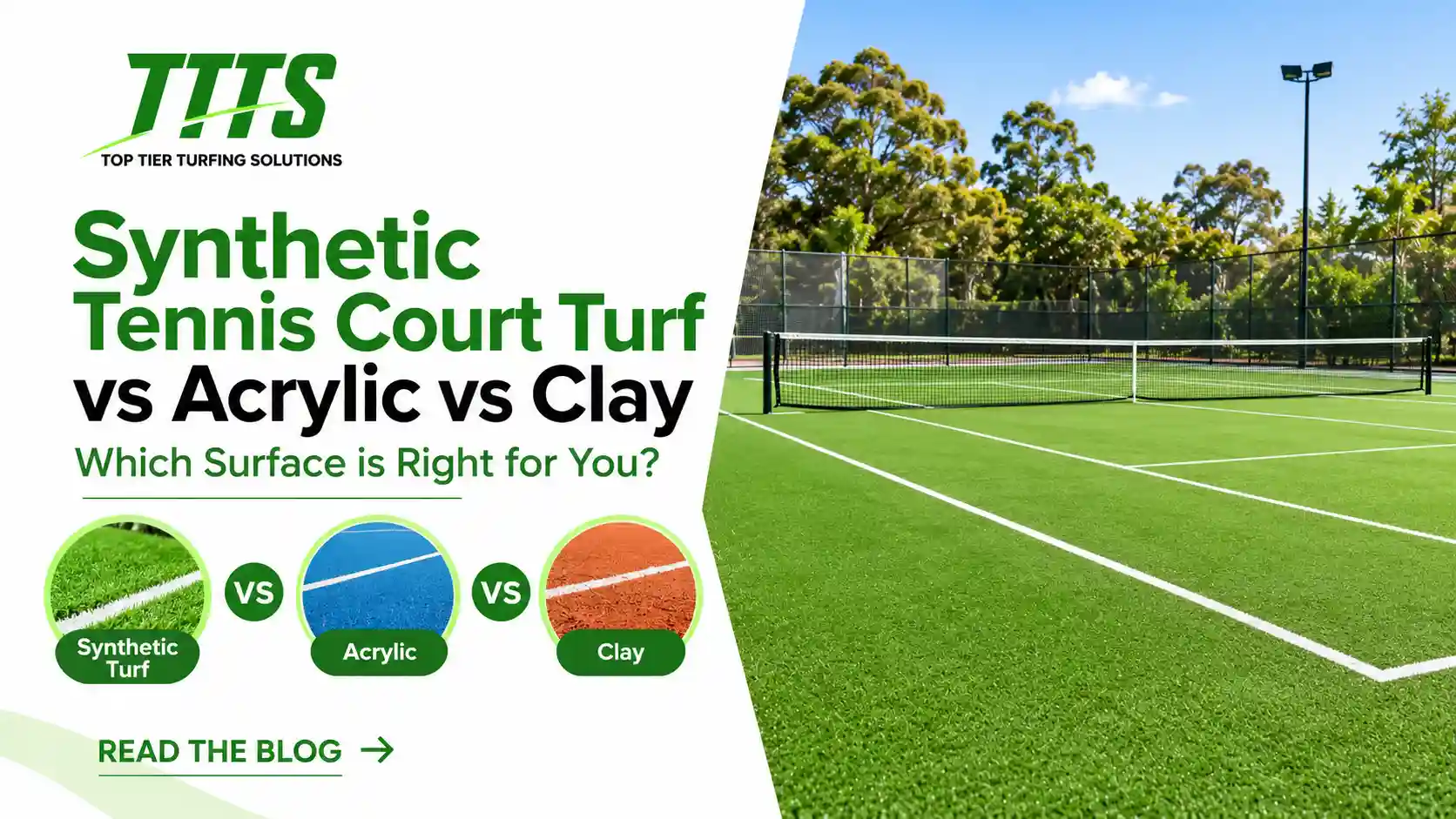
Synthetic tennis court turf vs acrylic vs clay: Which suits your backyard?
Share This Post
Planning to build a tennis court in your backyard? Choosing the right surface is an important first step. It affects how the ball bounces, how quickly it moves, how the court feels underfoot, and how much maintenance it needs.
Synthetic turf, acrylic and clay all offer different playing experiences. The right choice depends on your playing style, budget, available space, and how much time you can spend on upkeep.
If you’re planning a synthetic tennis court in Sydney, consider the local weather, drainage and how often you expect to use the court.
Let’s compare the three options to help you decide which one might work best for your backyard.
Synthetic tennis court turf vs acrylic vs clay: Key differences
| Feature | Synthetic tennis court turf | Acrylic hard court | Natural or synthetic clay |
| Ball speed | Often medium to fast | Medium, depending on the coating | Generally slow |
| Joint impact | May feel softer than an unpadded hard court, depending on the system | Firm; cushioned options are available | Allows sliding on suitable surfaces, but comfort depends on the court and playing technique. |
| Maintenance | Light brushing, cleaning and occasional infill top-ups where required | More cleaning, washing and occasional resurfacing | Frequent surface care, moisture management and line maintenance |
| Weather resistance | Can drain quickly if installed over a suitable base | Can dry quickly after rain, depending on conditions | Weather-sensitive and may need drying and preparation |
| Playing style | Suits professional players who enjoy a grass-like playing surface | Suitable for a broad range of playing styles | Suits players who enjoy slower rallies and topspin |
Playing conditions depend on the court’s materials and construction. Synthetic turf varies in its fibres, infill and speed. Acrylic courts may have extra cushioning, while clay courts differ in their materials and construction.
Cost and lifespan
The cost of a backyard tennis court depends on more than just the surface. Ground preparation, the base, drainage, fencing and other site requirements can all affect the total installation price.
Synthetic tennis turf needs a suitable base, turf materials and professional installation. It also requires regular maintenance and may eventually need repairs or replacement.
Acrylic courts need a properly prepared base and a special coating. This coating may need resurfacing over time, and the condition of the underlying base can affect its lifespan.
Clay courts can involve more specialised construction and regular upkeep, including watering and surface preparation. Their long-term costs depend on the type of clay and how often the court is used.
Installation costs and lifespan vary from one court to another. Ask your installer for a quote that covers the full installation, ongoing maintenance and future resurfacing or replacement costs.
Top Tier Turfing Solutions can help you choose the right turf, design and infill. Contact now.
Which surface is right for your backyard?
Synthetic tennis turf may be a good choice if you like the look of grass and want a surface that is relatively easy to maintain. Acrylic may suit you if you prefer a firm surface with consistent ball bounce. Clay may be ideal if you enjoy slower rallies and don’t mind the extra maintenance.
Before deciding, compare how each surface plays, the total installation cost, drainage needs and ongoing maintenance.
If you’re considering synthetic tennis turf for your backyard, Top Tier Turfing can help you explore your options.
Visit the synthetic tennis court page to learn more, or contact Top Tier Turfing to discuss your project and request a quote.
GET YOUR FREE QUOTE
Top Tier Turfing Solutions provides free on-site consultations across Sydney Metro, Penrith, the Blue Mountains and Wollongong. Call 1300 543 919 or request a callback at toptierturfingsolutions.com.au/fast-free-quote/.
 Natural vs synthetic turf in childcare centres: Cost & upkeep
About the Author: Top Tier Turfing